
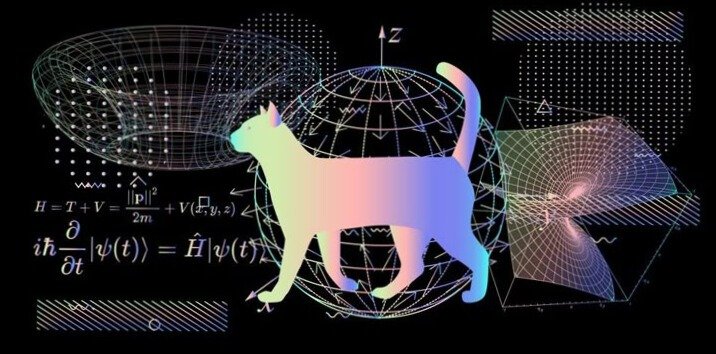
Two most interesting and intricate areas of modern day science are quantum physics and quantum mechanics. They describe the way in which the universe functions at the smallest scales possible, which are very much less than the atoms. Whereas classical physics deals with common things such as cars, planets, and falling apples, the quantum theory deals with particles so minute that laws of ordinary physics no longer govern them.
This paper will discuss the meaning of quantum physics and quantum mechanics, their relationship, and the primary types and subdisciplines of these subjects.
What Is Quantum Physics?

Quantum physics refers to the general science that is concerned with the behavior of matter and energy on extremely small scales, i.e. atoms, electrons, electromagnetic radiation and other subatomic particles. The term quantum is derived as the smallest possible unit of something, which is denoted by the Latin word quantus, which means how much.
There is no smooth flowing of energy in quantum physics. Rather it travels in small discrete packages known as quanta. To give an example, the light is not only a wave; it also exists as small particles known as photons.
Quantum physics is a problem to our common sense of reality. At the quantum level:
Particles may be present in warehousing conditions.
Particles may be entangled, that is, act upon each other at a long distance.
Measurement of a particle can never change its behavior.
Quantum physics is a general term that spans a variety of theories, experiments and mathematical models of one of the most significant, quantum mechanics.
What Is Quantum Mechanics?
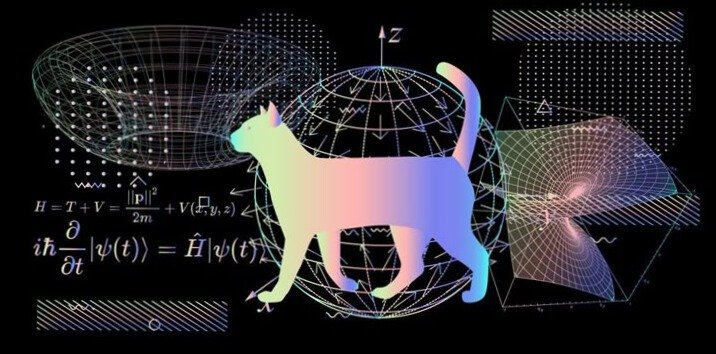
The fundamental theoretical system of quantum physics is quantum mechanics. It gives the mathematical laws and equations of the behavior and transformation of quantum systems with time.
In simple terms:
The overall field of study is quantum physics.
The primary theory in the said field is quantum mechanics.
Max Planck, Albert Einstein, Niels Bohr, Werner Heisenberg, and Erwin Schrodinger are some of the scientists who developed quantum mechanics in the early 20 th century. Their findings revealed that the classical physics was incapable of explaining the behavior of atoms.
Quantum mechanics explains:
The movement of electrons among atoms.
Why atoms give out or take up particular light colors.
How chemical bonds form
The mechanism of the modern technologies such as lasers and semiconductors.
The Major Principles of Quantum Mechanics.
In order to know quantum mechanics, it is better to know its main principles:
Wave-Particle Duality
Quantum particles act as waves and also as particles. Indicatively, electrons may behave as solid particles and also form wave like patterns of interference.
Superposition
A quantum system may be in a state considered to have a number of states until it is measured. The cat thought experiment of Schrodinger is a famous example of this idea.
Uncertainty Principle
This is the principle proposed by Werner Heisenberg, it is the case that you cannot know simultaneously the position of a particle and its momentum.
Quantum Entanglement
Once two particles are entangled, an instant interaction between the state of one and the other particle, regardless of their distance, is experienced.
Types and Branches of Quantum Physics and Quantum Mechanics.
The field of quantum physics is a big one and has a number of significant branches. The primary categories and fields of research are listed below:
Non-Relativistic Quantum Mechanics Relativistic Quantum Mechanics Relativistic Quantum Mechanics Relativistic Quantum Mechanics Relativistic Quantum Mechanics Relativistic Quantum Mechanics Relativistic Quantum Mechanics Relativistic Quantum Mechanics Relativistic Quantum Mechanics Relativistic Quantum Mechanics Relativistic Quantum Mechanics Relativistic Quantum Mechanics Relativistic Quantum Mechanics Relativistic Quantum Mechanics Relativistic Quantum Mechanics Relativistic Quantum Mechanics Relativistic Quantum Mechanics Relativistic Quantum Mechanics Relativ Non-Relativistic quantum mechanics represents a branch of quantum mechanics in which space and time do not vary depending on a certain field, and in which the field under consideration is not necessarily relativistic (that is, defined by relativistic invariance).
It is the most usually taught form of quantum mechanics. It is applicable to systems that are moving at very slow rates as compared to speed of light.
Key features:
Discusses atoms, molecules and electrons.
Uses Schrodinger’s equation
Foundations of chemistry and material science.
Applications:
Atomic structure
Chemical bonding
Spectroscopy
Relativistic Quantum Mechanics
This form is a quantum mechanics coupled with the theory of special relativity by Einstein. This is necessitated by the fact that when particles travel at speeds near the speed of light, it becomes necessary.
Key features:
Makes predictions on the presence of antimatter.
Uses formulae such as the Dirac equation.
Of relevance to high-energy physics.
Applications:
Particle accelerators
Nuclear physics
Astrophysics
Quantum Field Theory (QFT)
Quantum field theory does not consider particles as objects, but as degrees of freedom of the fields that are causing them. It is among the best established and precise theories in the science.
Key features:
Unites quantum mechanics and special relativity.
Elucidates fundamental forces (except gravity).
The foundation of the Standard Model of particle physics.
Applications:
Electromagnetism
Weak and strong nuclear forces.
Particle physics research
Quantum Electric Dynamics (QED)
Quantum electrodynamics is a branch of quantum field theory which studies the interaction of light (photons) and charged particles such as electrons.
Key features:
Elaborately accurate forecasts.
Describes the interaction of light and matter.
This is one of the best theories to be developed.
Applications:
Lasers
Atomic transitions
Precision measurements
Quantum Chromodynamics (QCD)
The strong nuclear force that holds the quarks together within protons and neutrons is referred to as quantum chromodynamics.
Read Also : AI in Education
Key features:
Deals with quarks and gluons
Explains nuclear stability
Works with complicated mathematical models.
Applications:
Nuclear physics
Experiments in particle colliders.
Knowledge of matter on the most fundamental level.
Quantum Statistical Mechanics.
This is the branch which examines large volumes of quantum particles, particularly in very low temperatures or high densities.
Key features:
Integrates quantum mechanics and statistics.
Describes the strange phases of matter.
Applications:
Bose-Einstein condensates
Superconductivity
Solid-state physics
Quantum Information and Quantum Computing.
This branch of modernity is concerned with the manner in which quantum systems store, process and transmit information.
Key features:
Represents classical bits with qubits.
Is based on superposition and entanglement.
Facilitates new and strong computing capabilities.
Applications:
Quantum computers
Quantum cryptography
Secure communication
Significance of Quantum Physics in the Contemporary Technology.
Quantum physics is not merely a theory – much of modern technology uses it:
Transistors and microchips
Lasers
Magnetic Resonance Imaging (MRI)
Solar panels
Smartphones and computers
Modern electronics and digital communication would otherwise not be possible without quantum mechanics.
Conclusion
Quantum physics/ quantum mechanics has revolutionized our perception of the universe. They expose the world in which particles act randomly, probability is used instead of certainty, and the very observation influences the world. Although quantum physics is the general science of the smallest scales in nature, quantum mechanics is its key theory, in which the mathematical means to describe that world may be found.
These theories have been used to influence science and technology since their explanation of the structure of atoms up to the creation of quantum computers. Despite the fact that quantum concepts are counterintuitive and unorthodox, they are one of the most significant intellectual accomplishments that humanity made and that they will need in order to advance physics and innovations in the future.