The Science Behind Active Learning Techniques: How Your Brain Actually Learns
Introduction: Your Brain Is Not a Sponge — It’s a Forge
Classrooms have long been working on a very dangerous assumption in that learning happens to students. A teacher speaks. A student listens. Knowledge transfers. Simple, clean, efficient.
But it is not like that.
What is Active Learning?
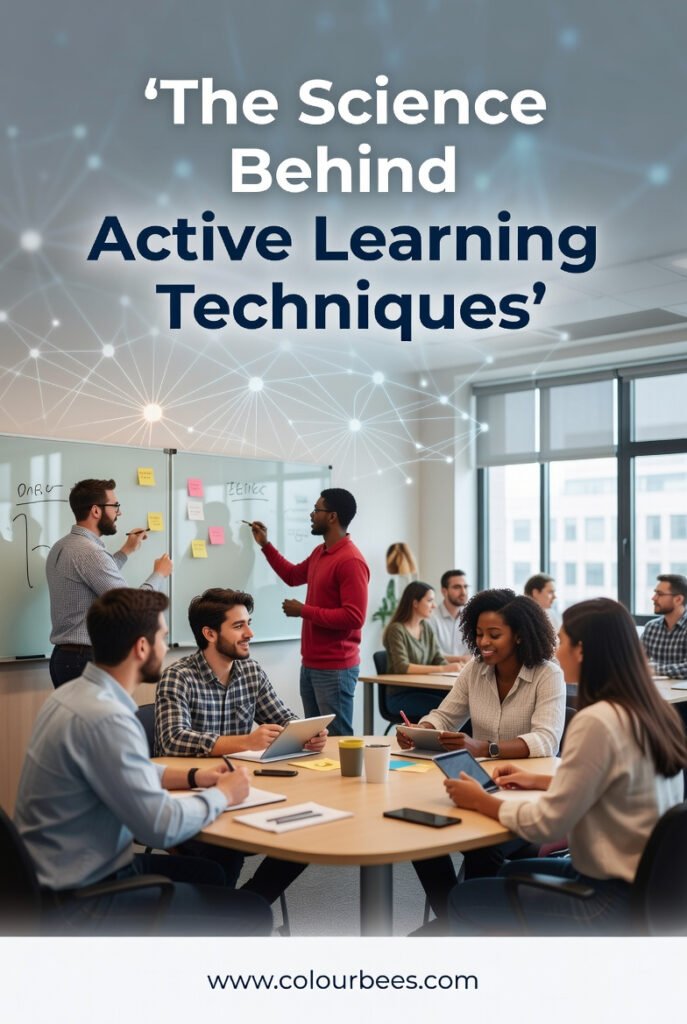
Active learning is an educational approach that engages students directly in the learning process through activities like discussion, problem-solving, and analysis, rather than passively receiving information via lectures. It emphasizes higher-order thinking, collaboration, and applying knowledge to, promoting deeper understanding and better retention
A human brain is not a passive information recipient. It is a pattern-loving, meaning-seeking organ that is active, and neuroscience has confirmed beyond a reasonable doubt that the manner in which you approach information is what makes it stick, fade, or never take note of it whatsoever. This is precisely one of the reasons why active methods of learning have swept through the education and corporate training, as well as self-improvement sectors of the world.
However, what exactly is going on in your head when you learn actively? Which chemical processes, brain organization, thinking mechanisms make active learning so mind-shattering effective in contrast to the mere reading or listening? Let’s go deep.
What exactly is active learning?
Active learning any method of instruction which involves a learner performing something with information – analyzing it, questioning it, applying it, teaching it, arguing it. It is the stark contrast to passive learning where a student is only fed something with no meaningful use of his mind.
It is not about physical activity or the power. You might be sitting in the same position using one of the most powerful active learning methods ever developed in existence, the Feynman Technique, just by picking up your textbook and attempting to narrate to yourself in simple language what you are learning.
Cognitive effort is what makes it active. The brain has to access, rebuild, interrelate and form.
The Neuroscience: What Goes on in a Working Brain.
Retrieval Practice Strengthening Synaptic Plasticity.
When you remember something that is in memory, you do not re-read it, therefore physically, your brain reinforces the neural networks that are related to that knowledge. This is part of the process which is long-term potentiation (LTP) and is realized through the release of glutamate and the opening of NMDA receptors, which literally fatten up the synaptic connections.
In one of the most important studies in 2011, Karpicke and Blunt (published in Science) contrasted the idea of concept mapping (a study method) with that of retrieval practice (test yourself). Students who saw the retrieved information remembered 50 percent of what they saw in a week as compared to those who studied in a detailed way. It is the pulling of information out rather than pushing it in which creates long term or permanent memory.
It forms the biological foundation of techniques of active learning based on retrieval such as flashcards, practice testing, and self-quizzing.
The Power of desirable difficulty.
UCLA cognitive psychologist Robert Bjork proposed the so-called desirable difficulties, the notion that the conditions that make learning more challenging at the moment lead to better retention in the long run. Your brain encodes the information in a stronger way when it is forced to think to retrieve or apply the information.
This difficulty is removed through passive learning. The re-reading of a textbook is easy and comfortable; a sense that psychologists call fluency illusion, which is a lie. Nothing has been learned in your brain, it is just a matching of patterns of the text that you know.
Vigorous struggle in its turn, causes an alarming reaction of the nervous system: it is important, record it right.

The Deep Processing and Prefrontal Cortex.
Proactive action activates the prefrontal cortex – reasoning, decision-making and abstract thinking. When students argue out, solve problems and ask questions instead of just being given answers, they can light up the region as bright as a city at night.
During active tasks (problem-solving, teaching others, applying concepts) compared to passive tasks, studies with fMRI scans have repeatedly demonstrated the broader and more intense activation in more brain regions, such as the hippocampus (consolidation of memories), anterior cingulate cortex (detection of errors), basal ganglia (formation of habits), etc.
Forgetting Curve and the Active Learning Antidote.
The 19 th -century German psychologist Hermann Ebbinghaus had made a sobering discovery: human beings forget a large part of newly acquired knowledge, about 50% in an hour, and as much as 90% in a week unless an effort is made to review the information.
His notorious Forgetting Curve showed this depreciation – but it showed something optimistic too: this curve is always reset when you actively retrieve and use information, and then it becomes flat.
That is why such scientifically proven active learning technique as spaced repetition is that powerful. Learners make weak short term memory permanent and turn it into iron clad long term knowledge by retrieving the information at strategically more and more increasing time intervals (e.g. after 1 day, 3 days, 7 days, 21 days).
The 5 science-based active learning strategies that actually work.

The Feynman Method: Learn to Teach.
It was named after Nobel Prize-winning physicist Richard Feynman, and this technique has you describe a concept in the manner that you would explain it to a child. As soon as you pass a blank spot, something you are not able to define, something you are not able to defend, you have found out precisely where your knowledge fails. Go back to the origin, stuff the hole, and get down to basics. This recursive cycle develops bulletproof understanding.
The science: The theory of generative processing demonstrates that generation of explanations results in greater encoding than intake.
Interleaved Practice: Scramble Your Study.
Rather than practicing one subject, then the next (blocked practice) interleaving involves combining subject or problem types. It is more difficult and messed up– and that is the thing.
The science: A 2010 study by Rohrer and Taylor revealed that interleaved practice could result in scores on exams as much as 43 points higher than blocked practice, since the brain has to over and over again figure out the strategy to apply, and this builds the networks of flexible problem-solving.
The Socratic Method: Ask All the Questions.
Instead of reciting answers, Socratic learning means physically pestering with constant questions of Why? and “What if?” until you come to ultimate principles. It has been applied in law schools, medical schools and philosophy departments across the globe and requires the brain to build knowledge as opposed to regurgitate it.
The science: Elaborative interviewing- asking/answering questions on the why – has been demonstrated to enhance recall as much as 72% as compared to just reading some similar material.
Problem-Based Learning (PBL)
In PBL, learners are exposed to complex and real-life problems without having been taught how to solve them. This failure that is fruitful prepares the brain to pursue patterns and thus the following teaching is dramatically more effective.
The science: A study conducted by Manu Kapur at ETH Zurich demonstrated that students who initially had problems performed worse than those who initially were directly taught the material, even when the struggling pupils had technically failed earlier.
Active Recall and The Pomodoro Technique.
The standard Pomodoro (25 minutes of intensive work, 5 minutes of rest) is multiplied many times more when the recesses are conducted in the form of active memory: laying away notes and writing down everything you have just learned.
The science: The testing effect which has been validated in over 100 studies demonstrates that the testing effect is more efficient than re-studying, since it is retrieval, not review, that consolidates memory.
The Reason Passive Learning is More Comfortable and less Effective.
This is one of the great ironies of the human cognition: the learning strategies that seem to be the most effective are the ones that are the least effective and vice versa.
Re-reading feels productive. It is systematic to point out. It is efficient to watch a video. Cognitive studies, however, have habitually categorized these as some of the most feeble approaches to learning since they avoid the effortful retrieval that actually constitutes the creation of memory.
In the meantime, the idea of studying before taking a test, teaching before learning, or having to solve a problem that you do not know how to solve all are frustrating, uncomfortable, even humiliating, but here again are the conditions in which the brain develops the most profound, long-lasting comprehension.
The uncomfortable thing is the learning.
Active Knowledge in Multiple Situations: Schools, Workplaces, and Beyond.
It is not only students who apply in the science. Corporate training research has shown that individuals who participate in simulation-based learning, peer coaching, and solving real-world problems are better learners (70) than those who are in conventional lecture-based training (the famous 70-20-10 learning model).
Case-based medical learning and clinical simulation have replaced most pure lecture-based medical school programs. The Socratic method is the law school life. The training of elite military is virtually all problem-based and experiential.
Its message is the same: the brain does not learn to rest on its laurels.
Summary: Be the Architect of your own Understanding.
The science is evident, the evidence is too much and the transformation is within the reach of every individual who is willing to experience the pain of an authentic cognitive task. Active learning methods are no fad, buzzword or trend within the education profession. They are an expression of the biological superstructure of the human brain to learn, store and utilize knowledge.
Read Also : Effective Study Plan
Whenever you test yourself, rather than re-read it, teach instead of review, fuss over a problem while you attempt to get it figured out until you find the answer, you are not merely studying harder. By studying this way, you are doing so in the most appropriate way possible according to the architecture of your brain.
The forge does not mould the metal with the use of a warm touch. It fashions it by heat, pressure and force.