AI in Education
Among the most disruptive elements in contemporary education is Artificial Intelligence (AI). It is not a buzz word anymore, but it is a dynamic tool that transforms the way students learn, the way teachers teach and the way educational institutions work. But so what is AI in education and what is its real purpose of benefit to students? Let’s explore.
What is AI in Education?
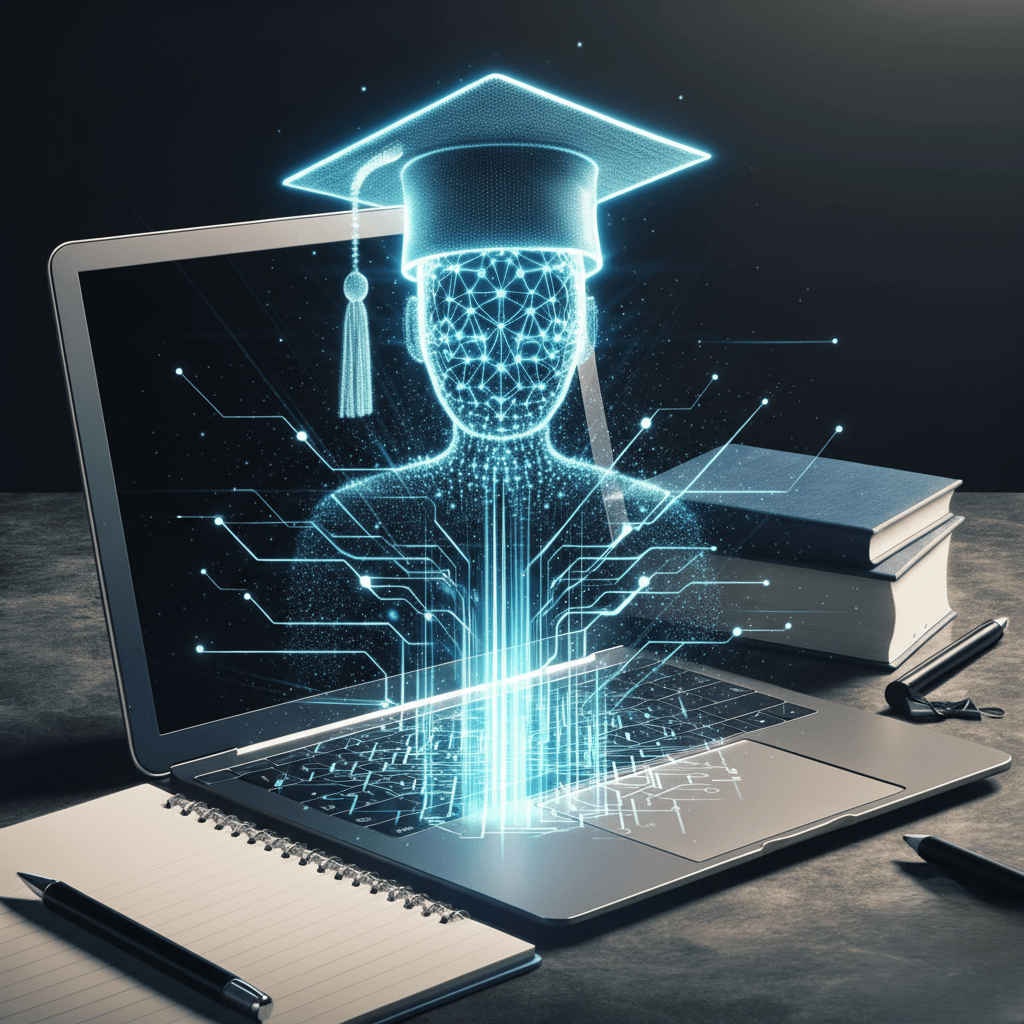
AI in education is the application of artificial intelligence technology to education, including machine learning, natural language processing, or data analytics to enhance teaching and learning processes. In the basic definition, AI assists the computers to think, learn, and make decisions as it is similar to human intelligence.
AI systems are able to analyze large amounts of data, determine patterns, and evolve over time unlike conventional software that operates under strict rules. This implies that in a learning environment, AI can:
Learning style of students.
Foresee academic achievement.
Provide individualized learning opportunities.
Completely automate tedious work among teachers.
Immediate feedback and assistance.
The truth of the matter is that AI in learning is a process that involves making the education process smarter, quicker, and more personalized.
Individualized Learning to ALL Students.
Personalization is considered as one of the largest benefits of AI in education. All students do not learn the same way, others are visual learners, some are audio or hands on learners. Artificial intelligence is capable of assessing the learning style, strengths, weaknesses, and the pace of a student to provide customised lessons.
Indicatively, when a learner has a weakness in algebra, AI-powered learning systems can detect certain problem areas and provide specific practice. It is also able to manipulate the level of difficulty according to the progress made to ensure that the students are not overpowered.
It is an important change that has been witnessed in adaptive learning as compared to the one size fits all model that normally leaves many students behind.
Constant Feedback and Continuous Improvement.
Traditional learning usually requires one to wait until teachers mark or tests are taken, which may take a day or even a week. AI eliminates this delay.
Quizzes, assignments, and practice exercises can be marked with instant feedback of the students using AI tools. This immediate assessment is useful to the student to notice errors as they happen and rectify them before the errors take root.
Additionally, AI will be able to give information about learning patterns. As an illustration, it can indicate what ideas a student constantly has trouble with, and this allows such a student to allocate more resources to specific areas. This will result in increased retention and performance in the long run.
Read Also : IELTS OR TOEFL
Virtual Assistants and AIs Tutors.
Virtual assistants and AI tutors are becoming a common thing in education. These systems are able to respond to questions, elaborate concepts, and take a student through an issue, and most of the time 24/7.
This implies that the students will be able to seek assistance during the off school hours without necessarily depending on teachers or classmates. Simulation of a human conversation can also be applied by AI tutors; thus, a more interactive and engaging learning process.
The greatest advantage would be accessibility-students of varied background and time delay can as well as receive good educational assistance any time they desire.
Improved Learning and Engagement with Gamification.
AI is also useful in engaging the process of learning. The numerous AI-driven platforms rely on gamification, such as rewards, level, and challenges, to encourage students.
This strategy makes learning to be interactive and not a passive process. It is possible to use simulations, virtual labs, and interactivity exercises to help the student learn complex topics in a simpler way.
AI can enhance motivation, decrease boredom, and bring more interests to the study of the subject because it makes education more fun and engaging.
Professional Development and Workload Reduction.
AI is not only beneficial to students, teachers will also find it helpful. Repetitive work like grading and attendance monitoring, and administrative work can be automated by AI.
This provides teachers with additional time to concentrate on the best things in life, which are teaching, mentoring and establishing meaningful relationships with the students. The AI may also enable teachers to receive evidence-based information on the effectiveness of their classes so that they can detect problematic learners at the initial stage.
Finally, AI enables educators to work more intelligently, rather than more intensely.
The Future of Higher Education.
AI is not a learning tool, it is a skill of the future. With the further implementation of AI in all sectors, students with knowledge of AI and its application will have an advantage in the employment market.
AI learning assists students to acquire critical thinking, problem-solving and digital literacy. It also promotes a culture of life-long learning, flexibility and innovativeness.
Artificial intelligence is not only advantageous in a world that is getting more and more technologically minded, it is crucial.
Final Thoughts
AI in learning is transforming the learning process of students. It renders learning individualized, interpersonal and effective. It offers immediate feedback, helps teachers, and trains students to work in the age of AI omnipresence.
With the adoption of AI, education becomes more embracing, dynamic and strong- unlocking new knowledge doors, which were previously unimaginable.