The Art of Power Dressing: Soldier or Diplomat?
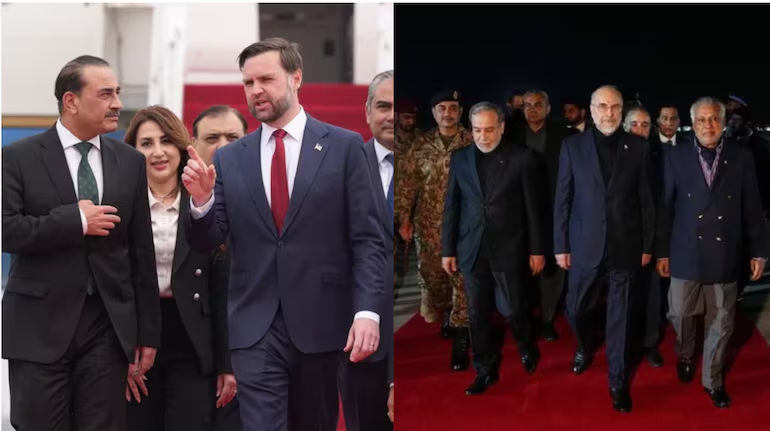
In the high stakes game of world geopolitics, communication is not always oral. At other times, one can say the deepest things with the cloth behind the back of a leader. Psychology dictates diplomacy, and as a student of power and influence, I have often seen how diplomacy is determined by psychology. Recently, a pair of opposite pictures of Field Marshal Asim Munir, a Pakistani, at the Islamabad Airport has created an international dialogue: one is military uniform, the other one is civilian clothing.
This isn’t a coincidence. Every button speaks and every color talks in the language of power.
Two pictures, Two personalities.
The Night Scene: Solidarity of the Soldier.
The Field Marshal welcomed the Speaker of the Iranian Parliament, Mohammad Baqer Qalibaf, in their complete military camouflage when he arrived in the evening, accompanied by the Foreign Minister, Araghchi. The outfit was an instantaneous message with the Pakistani flag on his shoulder and ranks on his chest.
Iran is a country that is already negotiating the legacies of war 40 days of bombardment, destroyed infrastructure and devastating human casualties. Wearing the uniform the Field Marshal sent a message: I am a soldier; I know how you feel, because I speak the language of the battlefield. It had formed an unspoken communication of trust with the Iranian Revolutionary Guard leadership-a message of Soldier to Soldier, which no civilian suit could have expressed.
The Day Scene: The Diplomatic Dialogue
Compare this to the visit of the U.S. Vice President JD Vance. The Field Marshal, under the glaring sun, stood on the red carpet in a keen civilian suit and tie.
It was plain to Washington, the message: I am a negotiator. I am here to sit at the table and not in the trenches. As per the Western democratic practices, in which the senior civilian leadership is customarily welcomed by their counterparts in civilian clothes, this decision was in reverence of American diplomatic traditions. It resembled his June 2025 appearance in the White House, where his civilian dress indicated that he was ready to participate in the language of treaties and commerce, as opposed to maneuvering.
A Tactical Attire Historical Precedent.
Strategic clothing is an instrument of the greatest leaders of all time:
Mustafa Kemal Ataturk: When receiving the defeated Greeks, he put on a military uniform to show that he was a conqueror, but a civilian suit when it came to negotiating with Europeans to represent Turkey as a modern and equal state.
Winston Churchill: He wore military-like clothes in WWII to demonstrate to the nation that he was a soldier but as soon as it became about rebuilding the country he renewed his suits.
Anwar Sadat: In 1977, he visited Israel in uniform to remind the world of his military might in 1973, but donned civilian attire when he traveled to Camp David peace talks to demonstrate he was willing to talk.
The Dual Personality Soldier and Diplomat.
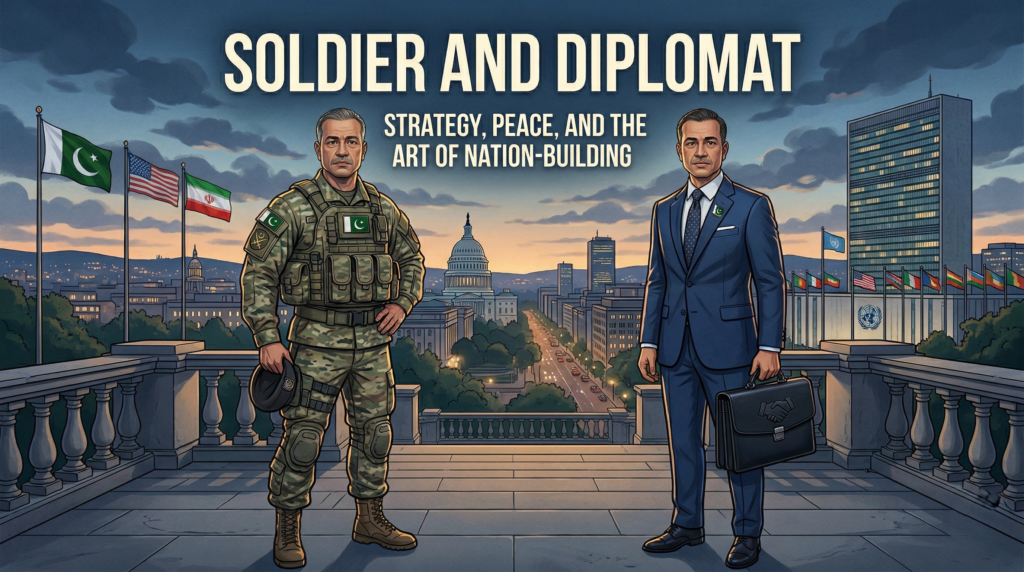
According to a recent article in Asia Times, Field Marshal Munir has developed a Soldier and Diplomat image. This is a duality that is needed in the present situation of Pakistan on the world stage.
To Iran: The uniform, – I am your brother in arms.
To the U.S.: I am a partner in policy, said the suit.
The encounter with JD Vance, a man with less hawkish opinions, in a suit allowed the Vice President to have dignified room as a civilian leader to maneuver. On the contrary, an Iranian delegation, the war zone visitors, would have seemed insensitive to the plight of the people in a suit.
Read Also : The Faces Behind the Ceasefire
The Conclusion: Speaking Every Language.
The real art of power is no mere strength, but the power of addressing each party in their own language. Islamabad is indicating that they can be a key mediator by switching between the uniform and the suit.
In the jumble of the 2026 scene, they will be the people who are between the spokes of the wagon. And the middle sitters are the writing historians.