
What Are Newton’s Laws of Motion? Easy Guide for Students
Have you ever asked yourself why a soccer ball does not stop rolling when you kick it? Or why bashing down the brakes tosses you out your seat? The solutions can be found in three beautiful concepts that are found by one of the most scientific minds in the history of mankind Sir Isaac Newton revealed in 300 years ago.
The basis of classical mechanics, the physics of motion (or inertia), is Newton Laws of Motion. You are in middle school and need to take your first physics test, or are a high schooler and want to learn more about the subject, this guide is all you need, as it breaks everything down in simple English. Let’s get into it.
Who Was Sir Isaac Newton?
We should know the man behind the laws before we plunge into the laws.
Sir Isaac Newton (1643-1727) was a mathematician, a physicist and an astronomer of England. In 1687 – his work, the Principia of Philosophiae Naturalis Principia Mathematica, was printed in a book, generally referred to as the Principia. He had outlined three laws in it which explain the interaction of forces and motion.
These laws were not mere theories, they were able to explain everything, falling apples, and planet orbits. The Laws of Motion laid down by Newton are still applied by engineers and scientists in the construction of cars, planes, bridges and rockets even in the present days.
What are the significance of the Laws of Motion of Newton to the students?
This is important when it comes to understanding the Newton Laws of Motion since they:
Provide the foundation of physics in school and university level.
Assist in describing the common sense phenomena that you see around you.
Required in the problem solving of force, mass, and acceleration.
Relate to other key subjects such as gravity, momentum and energy.
Test on standardized tests across the world.
When you master these three laws, much of classical physics then comes to you automatically.
Brief History The Three Laws of Motion.
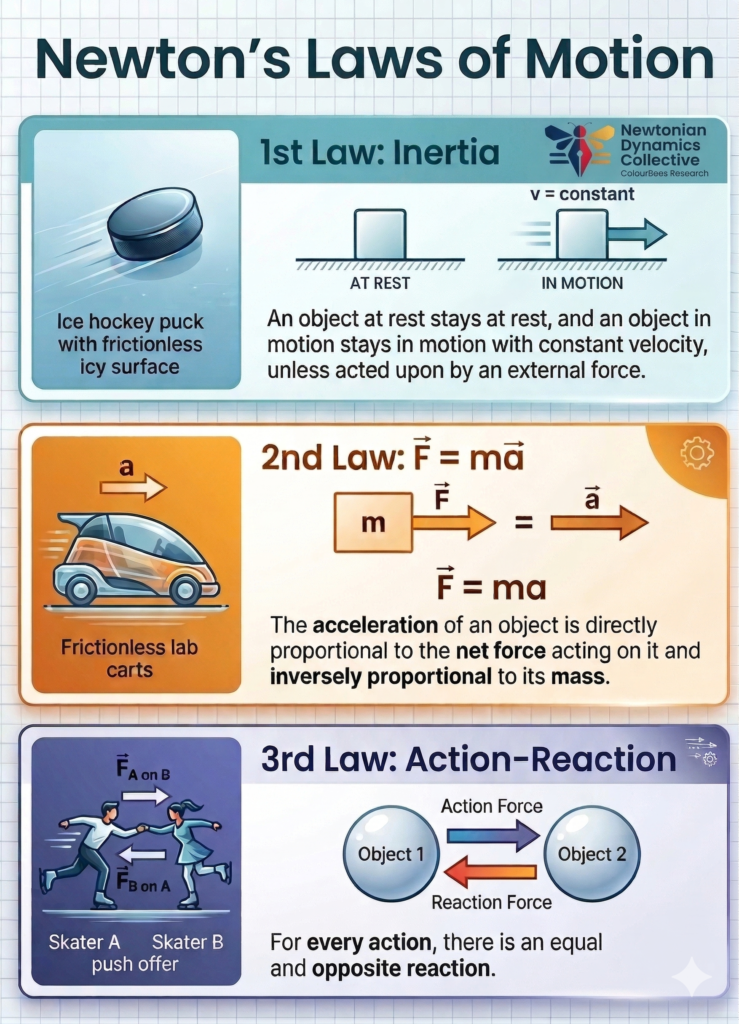
It has been customary to group Newton laws into three principles:
Law Name Core Idea
Law of Inertia First Law Objects do not like to be changed in their state of motion.
Second Law Law of Acceleration Force = mass acceleration (F = ma)
Third Law Law of Action-Reaction Every action is returned a thousand times over.
And now we will consider each of the laws one by one.
The First Law of Motion Newton: The Law of Inertia.
What Is the First Law?
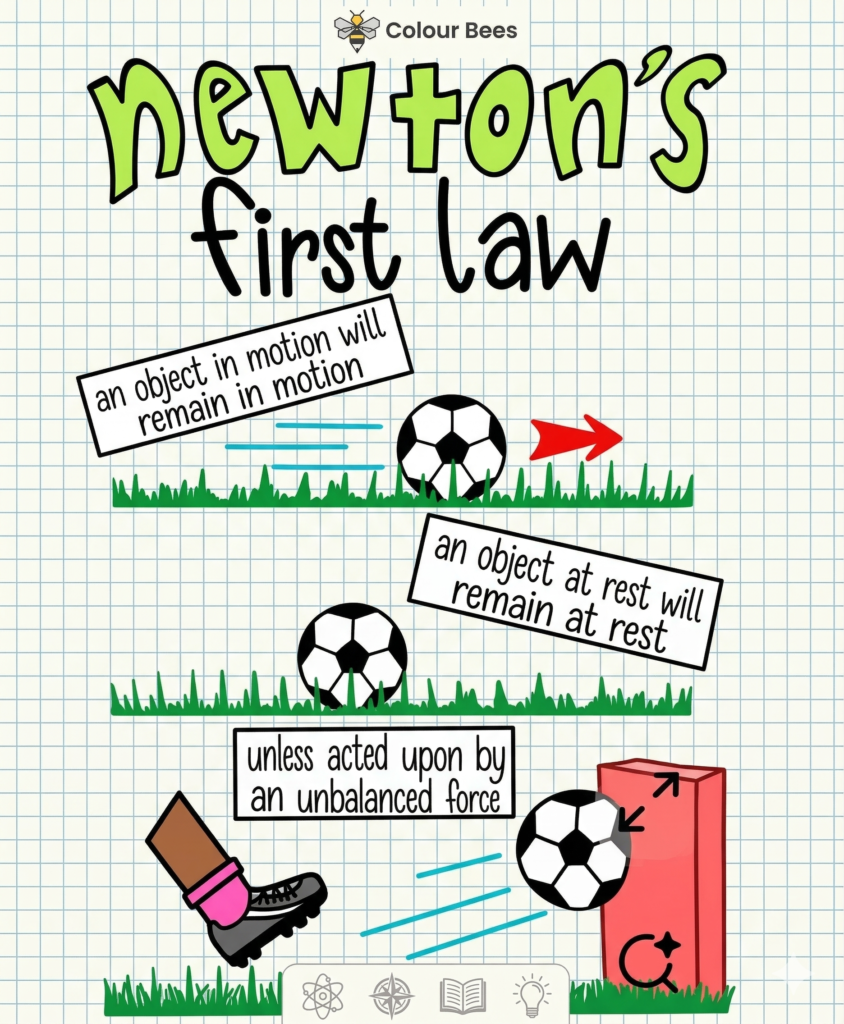
According to the First Law of Motion, Newton writes:
A body in rest remains in rest and a body in motion remains in motion with the same speed and with the same direction unless it is acted on by an unbalanced external force.
Simply put things do not change what they are doing unless something makes them change. When the book on the table is resting, it will not be able to move on its own on the table to the opposite side of the room. Assuming that a hockey puck is moving on ice, it would continue to move indefinitely assuming there is no friction.
What Is Inertia?
Inertia is the urge of an object against altering its movement. It is not a force, but is that which all objects of mass possess.
The heavier it is, the higher the inertia.
A ball used in bowling has greater inertia than a ball used in tennis.
It is difficult to move a loaded shopping cart when compared to an empty one hence it is harder to push.
Such real-life examples of the First Law.
Carmost car seat belts: When a car halts at a moment the body continues moving because of inertia. The seatbelt subjects you to an external force.
Tablecloth trick: This is pulling a tablecloth off of the bottom of dishes in a hurry – the dishes do not move due to their inertia.
Passengers bouncing on a bus: When there is braking of a bus, passengers are still going onwards. That’s inertia at work.
Second Law of Motion of Newton: Acceleration, Mass and Force.
What Is the Second Law?
Of the three Newton considered the Second Law of Motion to be the most mathematically potent. It states:
The planing force on an object is directly proportional to the acceleration of the object and in line with its mass.
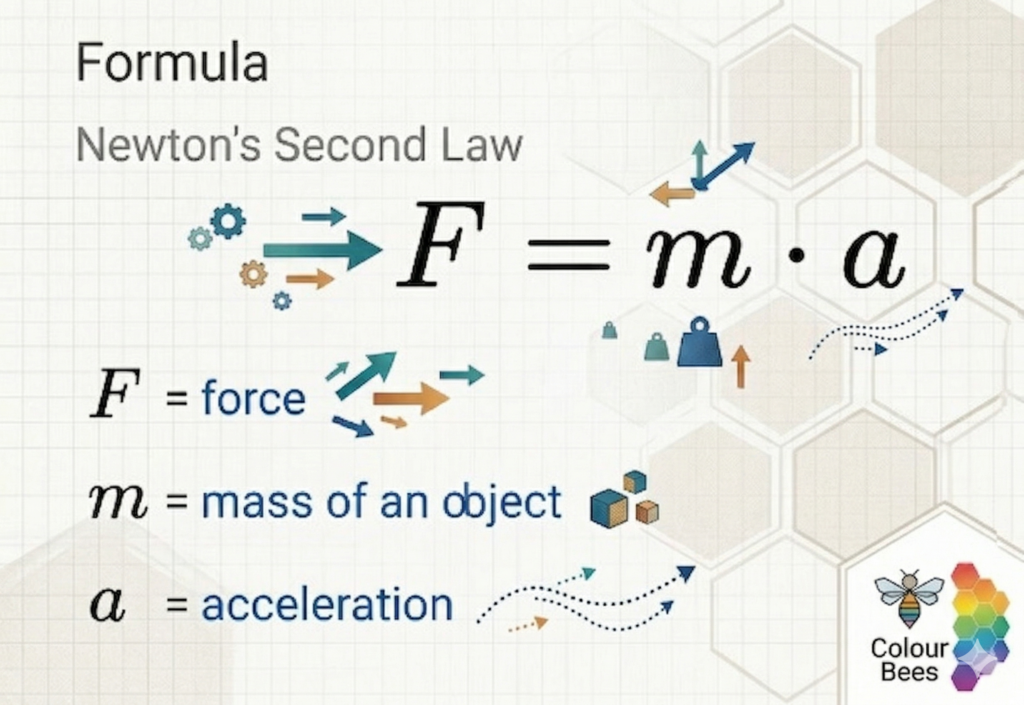
This has the following equation:
F = ma
Where:
F = Force (force measured in Newtons, N)
m = Mass (in kilograms, kg)
a = Acceleration (measured in meters per second squares, m/s2)
Breaking Down F = ma
And shall we make it very practical:
When you exert a bigger push (greater F) on the same object it accelerates faster.
With the same force, the heavier (the more mass) the object is, the slower it will accelerate.
One Newton of force provides a 1 kg body with an acceleration of 1 m/s2.
Real Life Applications of the Second Law.
Accelerating a car vs. accelerating a bicycle: Acceleration of a bicycle is much higher with a breeze of the same force when compared to the acceleration of a car since the later is of immense mass.
Blasting a baseball vs. a bowling ball: A baseball can be thrown with immense speed and you can hardly get the heavy bowling ball to move at the same speed using the same arm strength.
Rocket propulsion Engineers use F = ma to compute precisely the thrust required to accelerate a rocket of a certain mass into orbit.
How to Use F = ma in Problems
Here’s a quick example:
A weight of 10 kg is pushed against a force of 50 N. What is its acceleration?
Using F = ma – a = F/m:
a = 50 N / 10 kg = 5 m/s2
The box has an acceleration of 5 meters per second squared. Simple and powerful.
The Third Law of Motion Newton: Action and Reaction.
What Is the Third Law?
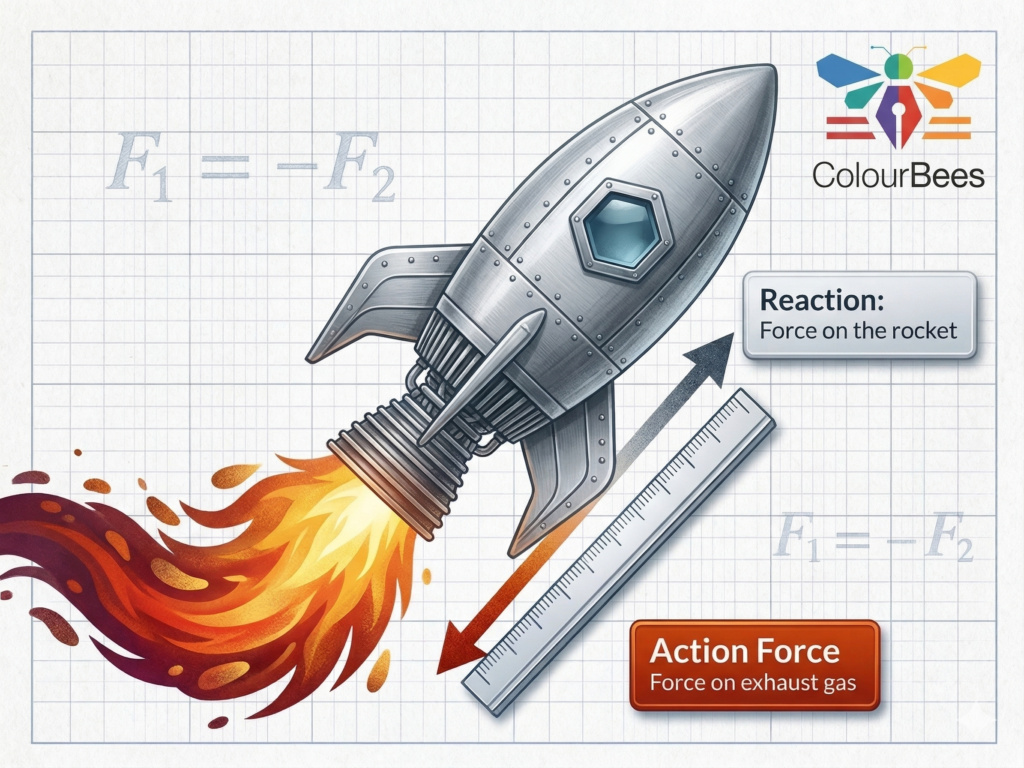
The Third Law of Motion of Newton is the following:
To every action there is a similar and converse reaction.
This implies that there are two forces. In the case where Object A applies force on Object B, Object B applies equal force on Object A in the opposite direction.
Knowing Action-Reaction Pairs.
The only important fact which students tend to overlook here is that the action and reaction forces act on different objects and not the same one. And that is why they do not cancel.
You put the earth down – the earth puts you up (that is the way you walk)
A rocket blows gas to the ground – the gas propels the rocket to the air.
You put the wall – the wall puts you back on your hand.
Actual Applications of the Third Law.
Swimming: Your hands send the water in reverse; your body is sent by the water.
Guns and recoil: When a bullet is fired forwards, the gun recoils backwards – the same and the opposite.
Jumping: You push down the earth; it pushes you up to the air.
Boat rowing: The paddle is by pushing backwards the water, the water is by pushing forward the boat.
The Interaction of the Three Laws.
Laws of Motion do not work individually, they interact continuously in the real life.
Consider a car crash:
First Law is the reason why passengers continue to move forward following an impact (inertia).
Second Law describes the seriousness of the injury – the heavier and the faster the car collides, the greater the impact.
Third Law describes the cause of experiencing the impact by both vehicles – both forces act on each other.
By knowing how they are interrelated, you are able to appreciate the classical mechanics and physics much more deeply.
The myths about the laws of Newton.
These are some of the pitfalls students will fall into:
The law that equal forces can cancel out is false. The action-reaction pairs have different objects as the objects of action.
A massier body drops more swiftly, – False. All objects fall at the same rate (at a vacuum). It is the Second Law of Newton on gravity.
An object requires a constant force to be in motion, which is false. The former Law informs us that motion persists without force. Dissension is what makes things drag.
F = ma only works when the object is big – False. It is applicable everywhere, both at the microscopic scale and at the macroscopic scale.
Newton’s Laws and Gravity
The three laws were not the end of Newton, he also discovered the Law of Universal Gravitation that is closely related to the Laws of Motion.
Sanctus is the force which makes bodies fall towards the earth. With F = ma and the acceleration due to gravity of 9.8 m/s 2, we can calculate the gravitational force of any object:
F = mg (where g = 9.8 m/s2)
So a 70 kg person weighs: F = 70 x 9.8 = 686 N
This is the reason why weight and mass are not one thing, mass is the amount of matter and weight is the force of gravity working on the amount of matter.
Student Advice: The Laws of Newton Fundamentals.
These are some of the tricks that will actually help in remembering:
First Law: Thinking lazy things- things are lazy and do not want to change. Unless compelled to do so, they remain in one place.
Second Law: You know F = ma as an equation in math, which you can use on a daily basis. The greater the force, the greater the speed; the greater the mass, the lesser the speed.
Third Law: It is a Conversation- whatever you say (action) you get a response (reaction).
Mnemonic trick: I Am Awesome- Inertia (Law 1), Acceleration (Law 2), Action-Reaction (Law 3).
Laws of Newton in Science and technology today.
Quite on the contrary, Newton Laws of Motion continue to drive state-of-the-art technology:
Space exploration: NASA applies these laws to determine the orbits and the spacecraft trajectories.
Crash tests and airbag deployment: The Second and Third Laws are applied in the design of automotive safety.
Sports science: Force and motion are studied in order to maximise performance among coaches and athletes.
Robotics and AI: Algorithms in motion planning of robots are based on Newtonian mechanics.
Civil engineering: Bridges and buildings are constructed in such a way that they are to be balanced.
Read Also
Quantum Physics and Quantum Mechanics.
Conclusion
The Laws of Motion presented by Newton are not just physics that was taught in a textbook, but it is a language that the universe speaks in its way about the movement of things. Since you get out of bed and get moving (First Law: the inertia of your body does not like the change), since you open a door (Third Law: the door does not want to open), these rules are all around you.
The ability to learn these three laws as a student is a great toolkit to not only learn physics exams, but also the physical world. Learn the concepts first, drill the formulae, and relate them to reality. When it bites, it bites forever.
The most common questions are listed below.Frequently Asked Questions (FAQs)

FAQ 1: What are the three laws of motion of Newton in a simple explanation?
The First Law of Newton states that objects that are not in motion cannot change their motion without an acting force. The Second Law is that force is the product of mass and acceleration (F ma). The Third Law tells that nothing acts without a return, that all things have their corresponding repercussion. Collectively, they describe what, and why things move in the manner that they do.
FAQ 2: How to memorise the Second Law of Newton the simplest possible way?
The simplest method is to memorise the equation F = ma and know the meaning of each letter: F is force (in Newtons), m mass (in kilogrammes) and a acceleration (in m/s2). Just imagine it as follows, the more force you apply to something (greater force) the faster it accelerates; the heavier it is (greater mass), the less it accelerates.
FAQ 3: What is the reason why Newton First Law is referred to as the Law of Inertia?
It is referred to as the Law of Inertia since inertia is the key concept the law explains. The natural property of all objects to oppose any alteration of their state of motion is called inertia. Things that are at rest desire to be at rest: things that are in motion desire to be in motion. The First Law of Newton merely puts this tendency in a formal scientific statement.
FAQ 4: Are Newton laws of motion applicable in space?
Yes – the Laws of Motion of Newton extend into space. Actually, they are more pure and can work in space where there are no air resistance and friction. A spacecraft that has been propelled with a specific velocity will travel with the same velocity forever unless some force (such as the gravitational pull of a planet) acts on it. This is the First Law of action ideal.