
Joint Awami Action Committee
Read Full In Urdu Click Here :
The Joint Awami Action Committee or JAAC, as it is called, is a grassroots civil-society coalition, also known as a sociopolitical movement, of the people of Pakistan-administered Azad Jammu and Kashmir (AJK). Established on 16 September 2023, it emerged from a movement to counter the surging inflation and is based in Muzaffarabad, with its headquarters.It was started from a movement against the rising price on 16 September 2023 and is the strongest protest movement the region has created in years with headquarters in Muzaffarabad.
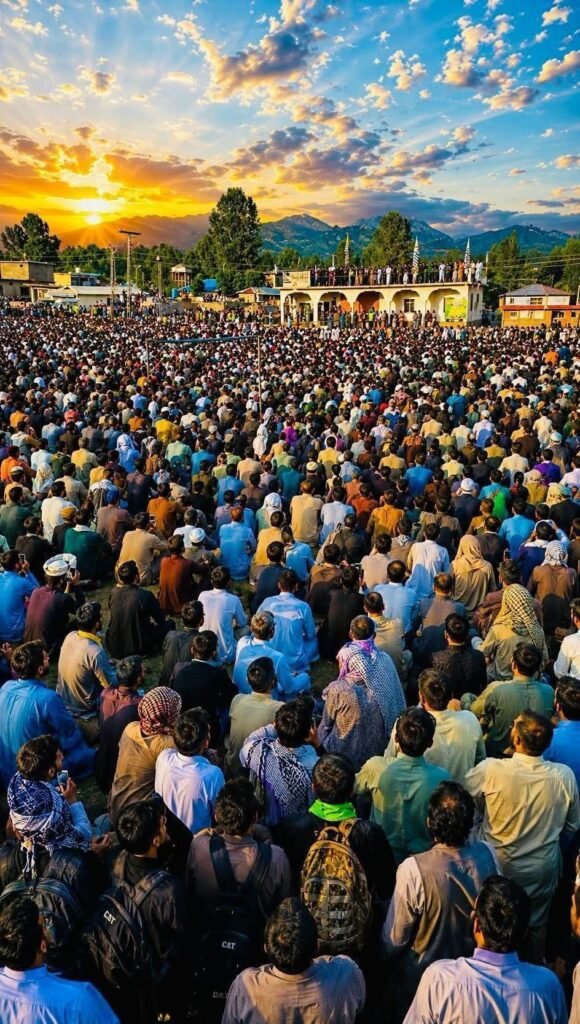
The committee’s name, awami means “of the people,” and that is exactly what the committee became: not a political party pursuing power, but rather an alliance of the people, pushing for economic and social justice. It began as a group of merchants, truckers, advocates, students and other citizen organizations, but developed into a vehicle for a wide range of the population, articulating both economic and political demands. It has been organising large scale strikes against the Government of Azad Kashmir since inception.
The structure of JAAC was what made it unique. It was not a single charismatic leader, but was managed by a small number of around 31 members who were drawn from a wide spectrum. Its leadership-less format also made it hard to control or eliminate the movement by arresting one of its leaders.
Origins: How the Movement Began
JAAC is born out of a common economic pain. By 2023, people of Azad Kashmir were facing increasing prices of wheat flour and electricity despite the fact that it is a region of rich hydroelectric potential and used to be provided free of cost. Activists contended that the public was paying exorbitant prices for these basic services while the privileged class of politicians and bureaucrats were taking advantage of those services for their own gain, all at public expense.
These frustrations were brought to a focus by the committee. The simple and human demands it sought were that flour prices are lowered and that electricity rates are adjusted according to the true cost of generating hydropower in its region. The movement gained rapidly momentum and spread to every district and attracted general public sympathy due to the complaints of these grievances that involved almost all the households.
Protests in the State of Azad Kashmir for 2024.
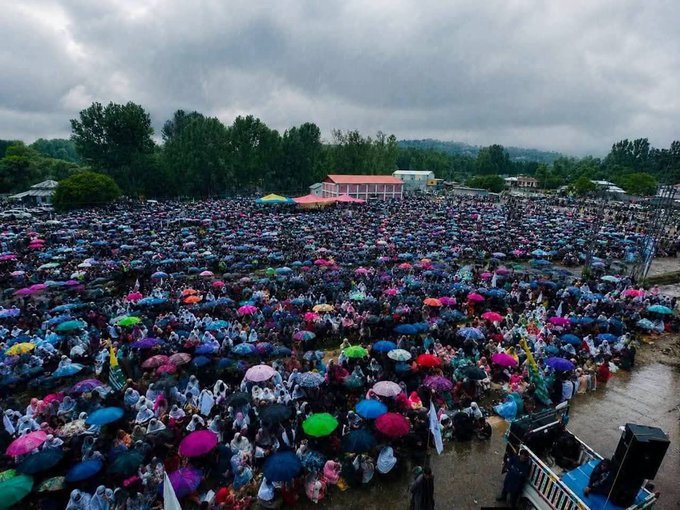
The first big flashpoint occurred in May of 2024. To get their demands, JAAC called for shutdown protests, wheel-jam protests and a long march towards Muzaffarabad. The government sought to prevent the planned protests by arresting movement leaders, a tactic that proved disastrous, as people grew angry and violent. During these protests, several people lost their lives.
The government initially started releasing billions of rupees of subsidy, in a bid to keep the price of flour and electricity down. The victory was important, early on. But the JAAC leaders grumbled that many concessions were only partially kept and that an ordinance banning public assembly was later used to curtail concessions won. The unrecolved grievances continued the movement.
The 38-Point Charter and the 2025 Escalation were also discussed.Also discussed were the 38-Point Charter and the 2025 Escalation.
The situation of JAAC exploded in September and October 2025. It issued a comprehensive 38-point charter of demands and it initiated a region-wide wheel-jam and shut-down strike. The charter was more than just flour and electricity; it was a wide-ranging and comprehensive divide between the immediate economic relief and structural change.
Economic relief:
Reinstatement of subsidy on flour and provision of protection on wheat flour (subsidized prices as compared to neighbouring areas of Gilgit-Baltistan)
Reduced power tariffs, based on the cost of electricity production from local hydro-projects like Mangla Dam, by a significant margin.
Structural reform:
The end of privileges and benefits for rulers, bureaucrats and the political elite.
An independent election body and electoral reforms.
The 12 seats of the AJK Legislative Assembly are to be abolished as ‘refugee’ seats.
Combining identical populations in the same constituencies based on the principle of population parity.Population parity and the redistribution of constituencies.
A clear and open judicial body to look into violence against protesters.
The 2025 strike went violent, in which approximately 10 people were killed and more than a hundred people were injured. The government put in place a communications blockade to prevent the uprising from spreading. The parties inked the “38-Point Agenda” (reform and relief) on 3 October 2025 in Muzaffarabad. The government said it had agreed to most of the demands, but the protest leaders said there was no actual implementation, and they vowed to press on until every one of the demands was met.
The most contentious issue, The 12 Refugee Seats:
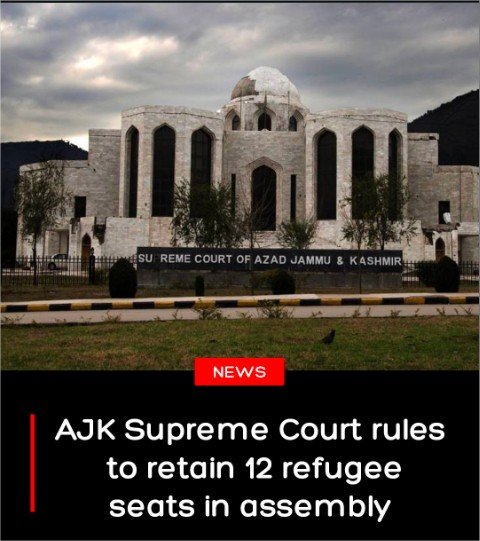
The most intense of all the demands was for 12 seats in the AJK Assembly for the refugees. These seats were earmarked for Kashmiri refugees from the Indian administered Jammu and Kashmir who were settled in Pakistan and were also provided for in the interim constitution of the region as a representation of the provisional government of the AJK.
JAAC claimed that the seats had a distorting effect on democratic representation and led to an entrenched elite control. Defenders responded that their removal would mean the end of the political symbolism of Kashmir. This one issue became the focus of the subsequent mobilisations.
Why JAAC Was Banned
The Azad Jammu and Kashmir government put JAAC under the First Schedule of the anti-terrorism act of the region in June 2026 (5 June 2026). The official notification alleged that the group was involved in “terrorism” activities, “creating anarchy”, “intimidating the public” and “promoting insecurity.” Local authorities also said that JAAC had been in conflict with police, and killed, abducted and tortured local police officers. The ban essentially ended the committee as a formally organized group, after it had been active for essentially three years.
The decision was highly controversial. JAAC and several observers have rebutted the claims, the committee saying that members of the Armed Forces, including the Punjab Rangers, murdered, abducted and tortured JAAC members and protesters. But critics, including human rights observers, said the movement was primarily a peaceful grassroots response to the underlying economic complaints and that labelling it “terrorism” was a way to squelch them rather than solve the problem. Those who opposed the ban said the extended strikes and lockdowns were interfering with citizens’ daily lives and were damaging the very people they said they stood for.
The Movement is a reflection of the state of Azad Kashmir.The Movement reflects the condition of Azad Kashmir.
JAAC was one of the deeper, long-running issues concerning governance, political representation, resource distribution and autonomy of region in Pakistan-administered Kashmir. The flashpoints were a sign of a structural question: Who controls the area’s resources, and what are the gains for them?
Read Also: 1949 Karachi Agreements
The movement was part of a broader trend across the world. As with other youth movements, it tapped into a disenfranchised, disillusioned younger generation who were angry about corruption, inequality, jobs and high prices. If there is no formal committee or not, the grievances that gave rise to it are not resolved.
| Detail | Information |
|---|---|
| Full name | Jammu Kashmir Joint Awami Action Committee (JKJAAC) |
| Founded | 16 September 2023 |
| Headquarters | Muzaffarabad, AJK |
| Type | Grassroots civil-society / sociopolitical coalition |
| Leadership | Core committee of ~31 members (no single leader) |
| Core demands | 38-Point Charter (flour subsidy, fair power tariffs, abolition of elite privileges & 12 refugee seats, electoral reform) |
| Major protests | May 2024; September–October 2025; JUNE 2026(Ongoing) |
| Key agreement | “38-Point Agenda” signed 3 October 2025 |
| Banned | 5 June 2026, under the Anti-Terrorism Act |
Conclusion
At its core, the JAAC was a people-powered initiative, which transformed a kitchen-table economics issue, ranging from the price of flour to a power bill, into a long-term challenge to an entrenched privilege in Azad Kashmir. It forced major concessions, helped to reveal systemic governance inadequacies and changed the course of the political dialogue in the region through 2024 and 2025 protests before it was banned in the following year, 2026. It is as many observers have pointed out that a ban will take an organization out of the formal landscape, but not out of the realm of grievances that made the organization.