


Introduction
Rationalism stands as one of the most transformative philosophical traditions in human intellectual history. At its core, this approach champions reason as the supreme source of knowledge and truth. From the marble halls of ancient Athens to the universities of modern Europe, rationalism has fundamentally shaped our understanding of mathematics, science, ethics, and the nature of reality itself. This exploration examines how rational thought became a cornerstone of Western philosophy and why it remains indispensable today.

René Descartes Portrait of the French philosopher and mathematician René Descartes, oil on oak by Frans Hals, c. 1649; in the National Gallery of Denmark.
What Is Rationalism? Core Definition
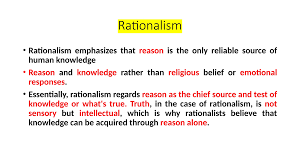
The rationalism definition describes a philosophical doctrine asserting that reason serves as the chief source and test of knowledge. Rationalists maintain that certain fundamental truths can be known independently of sensory experience through what philosophers call a priori knowledge understanding derived from reasoning alone rather than observation.
In practical terms, rationalism proposes that the human mind possesses inherent capabilities to discover essential truths about reality through logical analysis. Consider mathematical propositions: we understand that two plus two equals four not because we’ve physically counted objects repeatedly, but because our rational faculties reveal this truth directly. We don’t require empirical confirmation for such self-evident principles.
Rationalists embrace several core beliefs:
- Knowledge emerges through logical deduction from first principles
- Certain ideas are innate, existing within the mind from birth
- Reason provides greater reliability than sensory perception
- Universal truths exist independently of individual experience or cultural context
- The mind’s rational structure allows access to necessary, eternal truths
This philosophical stance fundamentally differs from approaches prioritizing observation and experimentation, positioning rationalism as a distinctive way of understanding how humans acquire genuine knowledge.
The History of Rationalism: From Ancient Greece to the Enlightenment
Rationalism in the Ancient World
The history of rationalism begins in ancient Greece, where philosophers initiated a revolutionary shift from mythological explanations toward logical, systematic inquiry into nature and existence.
Pythagoras (570–495 BCE) pioneered the rationalist perspective by discovering that mathematical relationships govern the universe. His work in geometry and numerical theory demonstrated that rational principles form reality’s foundation. The Pythagorean theorem exemplifies how pure reasoning reveals eternal truths about spatial relationships.
Socrates (469–399 BCE) advanced rationalism through his dialectical method. By employing structured questioning and logical dialogue—the famous Socratic Method—he demonstrated that rigorous reasoning leads to clearer understanding than accepting received opinions uncritically. Socrates believed that truth emerges through rational examination rather than sensory observation.
Plato (427–347 BCE) emerged as antiquity’s most influential rationalist. His Theory of Forms proposed that the physical world merely reflects perfect, eternal Forms or Ideas existing in a transcendent realm accessible only through reason. According to Plato, sensory experience provides unreliable impressions, while philosophical contemplation enables the mind to grasp ultimate reality.
Plato’s famous Allegory of the Cave illustrates this principle vividly. Prisoners mistake shadows on cave walls for reality itself. Only through reason and intellectual awakening can someone perceive true reality beyond sensory illusions. We might observe many beautiful objects, but the concept of “beauty itself” exists as a rational idea transcending physical examples.
These ancient thinkers established rationalism’s foundational principle: the material world experienced through our senses represents an imperfect version of higher truths that reason alone comprehends.
Medieval Rationalism
During the medieval period, rationalist ideas merged with religious thought. Philosophers like Augustine of Hippo integrated Platonic rationalism with Christian theology, arguing that divine truth illuminates the mind. Later, Thomas Aquinas synthesized Aristotelian philosophy with Christian doctrine, maintaining that while empirical observation has value, reason plays the crucial role in understanding both natural and divine truth.
The Modern Era: Rationalism’s Golden Age
Rationalism reached its zenith during the 17th century in continental Europe, an epoch often called the Age of Reason. This period produced philosophy’s most systematic rationalist thinkers.
Major Rationalist Philosophers and Their Contributions
René Descartes (1596–1650): Father of Modern Rationalism

René Descartes revolutionized philosophy by establishing modern rationalism’s methodological foundation. His famous declaration, “Cogito, ergo sum” (“I think, therefore I am”), demonstrates his conviction that reason provides the bedrock of certainty.
Descartes employed systematic doubt, questioning everything susceptible to doubt—including sensory perception and physical existence. He concluded that while he could doubt his body’s existence and the external world’s reality, he could not doubt that he was thinking. The very act of doubting proved his existence as a thinking being.
From this indubitable foundation, Descartes constructed an entire philosophical system through reason alone. He argued for innate ideas, including mathematical truths and the concept of God, claiming these emerge from the mind’s rational structure rather than sensory experience. His emphasis on clear and distinct ideas derived from reason established the standard for philosophical certainty.
Baruch Spinoza (1632–1677): Geometric Rationalism
Baruch Spinoza developed perhaps rationalism’s most rigorous systematic expression. His masterwork, Ethics, presents philosophy in geometric form—complete with axioms, definitions, propositions, and logical proofs modeled after Euclidean geometry.
Spinoza believed that everything follows from the nature of substance (which he identified with God or Nature) through rational necessity. He maintained that by understanding the world through reason, humans achieve intellectual freedom and genuine peace. For Spinoza, emotions should be understood rationally, and ethical living emerges from comprehending reality’s rational structure.
Gottfried Wilhelm Leibniz (1646–1716): Universal Reason
Gottfried Wilhelm Leibniz envisioned rationalism’s most ambitious scope. He proposed a universal rational language—a characteristica universalis—that could resolve all disputes through calculation. His famous dictum, “we should sit down and calculate,” expressed his belief that reason could solve any intellectual problem.
Leibniz developed sophisticated metaphysical theories, including his concept of monads—simple, indivisible substances comprising reality. He argued that the universe operates according to rational principles established by God, governed by pre-established harmony. Leibniz championed innate ideas and believed that all truths of reason could be discovered through logical analysis from first principles.
The Principles of Rationalism: Core Tenets Explained
Understanding the principles of rationalism requires examining the interconnected ideas distinguishing this philosophical approach:
1. The Primacy of Reason
Rationalism elevates reason as the highest authority in acquiring knowledge. While sensory information provides useful data, rationalists argue that reason delivers certainty that perception cannot match. The senses can deceive us—optical illusions, dreams, and hallucinations demonstrate this vulnerability—but logical deduction from self-evident principles yields unshakeable knowledge.
2. Innate Ideas
Many rationalists maintain that humans possess innate ideas—concepts and knowledge present in the mind from birth or discoverable through pure thought rather than learned from experience. These aren’t acquired through sensory input but emerge from the mind’s inherent rational structure. Mathematical concepts, logical principles, and fundamental metaphysical truths exemplify this innate knowledge.
3. A Priori Knowledge
Rationalism strongly supports knowledge existing independently of experience. A priori truths can be known before or without sensory confirmation. Mathematical propositions, logical laws, and necessary truths fall into this category. For instance, we know that contradictions cannot be true without observing every possible contradiction.
4. The Deductive Method
Rationalists favor deductive reasoning—starting from general, self-evident principles and deriving specific conclusions through logical inference. This contrasts with inductive reasoning, which generalizes from particular observations. Mathematics exemplifies rationalist methodology: from a few axioms, entire systems of knowledge unfold through logical deduction. Euclid’s Elements demonstrates how geometric truths derive from rational first principles rather than measurement.
5. Universal and Necessary Truths
Rationalism holds that certain truths are universal and necessary—they apply everywhere, always, and couldn’t be otherwise. These truths don’t depend on individual experiences, cultural differences, or empirical circumstances. The laws of logic and mathematical relationships represent such necessary truths.
Rationalism vs Empiricism: A Defining Philosophical Debate
The contrast between rationalism and empiricism constitutes one of philosophy’s most significant debates, fundamentally shaping modern epistemology.
Empiricists like John Locke, David Hume, and George Berkeley argue that all knowledge ultimately derives from sensory experience. Locke famously proposed that the mind begins as a tabula rasa or “blank slate,” written upon entirely by experience. Empiricists reject innate ideas, insisting that even abstract concepts originate from sensory impressions.
Rationalists counter that while experience provides important information, reason accesses truths that observation alone cannot establish. They point to mathematics and logic as domains where knowledge clearly transcends sensory input.
This debate profoundly influenced philosophical development. The rationalist emphasis on mathematics and logical deduction shaped approaches to knowledge differently than empiricist focus on natural science and observation. Eventually, Immanuel Kant attempted a grand synthesis, arguing that while experience provides knowledge’s content, reason provides its necessary structure. According to Kant, both rationalist and empiricist insights contain partial truths requiring integration.
The Enduring Importance of Rationalism in Modern Times
Rationalism’s influence extends far beyond historical philosophy, remaining vital in contemporary intellectual life across multiple domains:
Mathematics and Logic: Modern mathematics relies fundamentally on rationalist principles of deductive reasoning from axioms. Pure mathematics develops through logical proof rather than empirical testing, exemplifying rationalist methodology.
Scientific Reasoning: While science incorporates empirical observation, it depends equally on rational hypothesis formation, mathematical modeling, and logical inference. Scientific theories often begin as rational hypotheses subsequently tested empirically, combining both rationalist and empiricist approaches.
Computer Science and Artificial Intelligence: Programming, algorithms, and computational logic directly apply rationalist principles. AI development particularly draws on formal logic and rational decision theory.
Ethics and Political Philosophy: Rationalist traditions inform approaches to moral philosophy that seek universal ethical principles discoverable through reason rather than cultural convention alone.
Critical Thinking and Education: Modern education emphasizes analytical thinking, logical evaluation, and systematic reasoning—all reflecting rationalist commitments. In an era of information overload and misinformation, the rationalist emphasis on logical analysis provides essential tools for distinguishing truth from falsehood.
Legal Reasoning: Jurisprudence applies deductive reasoning from legal principles to specific cases, demonstrating rationalist methodology’s practical application.
Conclusion: Rationalism’s Lasting Legacy
Rationalism represents a foundational philosophical doctrine asserting that reason serves as knowledge’s primary source. From ancient Greek philosophy through Enlightenment thinkers like Descartes, Spinoza, and Leibniz, rationalism has profoundly shaped intellectual history and continues influencing how we understand truth, knowledge, and reality.
Its core principles—innate ideas, deductive reasoning, a priori knowledge, and the primacy of reason—remain central to mathematics, logic, science, ethics, and critical inquiry. The rationalist philosophers discussed here demonstrated that the human mind possesses remarkable capabilities to discover truth through thought itself, transcending the immediate limitations of sensory experience.
While contemporary philosophy recognizes both rationalist and empiricist insights as valuable, rationalism’s enduring contribution lies in affirming reason’s power to access universal truths. Whether developing mathematical proofs, formulating scientific theories, analyzing ethical dilemmas, or programming intelligent systems, we continue employing rationalist principles established centuries ago.
Read Also : Quantum Physics vs Quantum Mechanics
Understanding rationalism enriches our appreciation of how human beings seek knowledge and truth. It reminds us that systematic thought, logical analysis, and intellectual rigor constitute essential components of the examined life—a testament to reason’s enduring power in advancing human civilization and understanding.